
Community Solar Pros and Cons: Exploring the Criticisms
.png)

.png)
April 28, 2026
Solar energy gets people talking…and not always kindly. Community solar is no different.
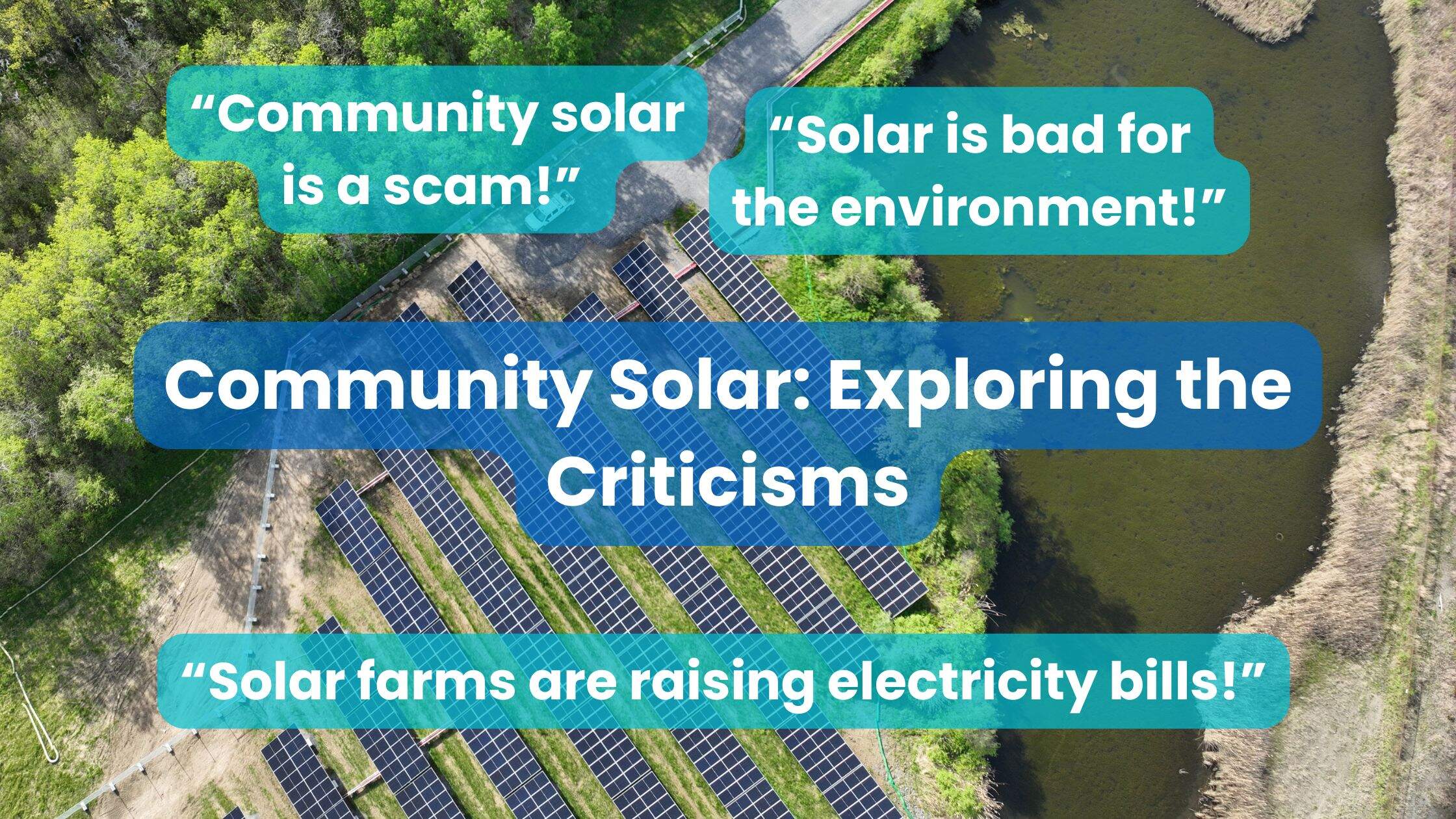
If you’ve spent any time in our social media comment sections, you may have seen some strong opinions about community solar programs and their impact on electricity rates or the environment.
While the concerns are valid and important to consider, not all critiques are entirely accurate, and some differ depending on the type of solar project and community solar provider.
Let’s look at common concerns and separate valid critiques from persistent myths to better understand the pros and cons of community solar.
"Community solar is a scam!”
Bottom line: Community solar itself is not a scam, but like any product, programs and providers vary. Community solar is a state-legislated program designed to help homes and businesses save money on electricity.
While it may sound too good to be true, community solar programs are designed to provide savings compared to standard electric supply without installing panels on your roof. The exact savings, contract terms, and fees vary by state, utility, and community solar provider. It's important to know your contract terms when signing up for a community solar program.
At Nautilus Solar, here’s how it works:
- Homes and businesses sign up to receive a share of a local community solar farm’s energy. That solar energy is sent to the electric grid, and customers receive credits on their electric bill for their share.
- The credited solar energy is billed at a 5-25% discount!
The U.S. Department of Energy also provides information about community solar programs.
“You’re taking away farmland. Solar belongs on buildings and parking lots.”
Bottom line: We agree there should be more of this development, but they aren’t the whole solution. In many cases, community solar is developed on remediated or previously disturbed land.
Installing solar on buildings and over parking lots makes a lot of sense and is an important part of the energy transition. The challenge is that these can often be more complex and expensive due to extra structural reinforcement and engineering requirements.
Land-use concerns apply to all forms of energy generation. Fortunately, community solar projects are increasingly designed to minimize land impact through site selection and dual-use practices. At Nautilus Solar, we've built community solar farms on remediated land including:
- A contaminated former army depot
- An old circuit board recycling facility
- Landfills, and brownfield sites
Solar also doesn't always have to come at the expense of farming. With agrivoltaics, landowners can graze their sheep, support pollinators, or even grow crops under and around the panels.
“Solar farms are raising electricity rates.”
Bottom line: Community solar isn't the primary driver of rising rates. Over time, fuel prices and infrastructure have a greater impact on electricity costs.
Any new energy project comes with upfront costs, but over time, electricity bills are driven more by fuel prices and grid infrastructure.
- Sunlight is free. Coal and gas are not. When gas prices spike, utilities feel it, and you will too.
- Once built, community solar farms have low and predictable operating costs.
Community solar programs give local residents access to discounted solar energy. These programs are designed to help reduce electricity costs.
For many renters and fixed-income households, community solar is the first time they've ever been able to benefit from clean energy savings.
“Solar farms do absolutely nothing for the people around them.”
Bottom line: When done right, the benefits of community solar stay local.
If a community solar farm is built without local engagement, it can feel disconnected and invasive. But responsible solar development brings tangible benefits to locals including:
- Steady lease payments to landowners.
- Local construction and maintenance jobs.
- New source of tax revenue for schools and municipal services.
- Local homes and businesses can enroll to receive discounts on their monthly electricity bills.
“Let’s pretend we’re saving the world by destroying the environment.”
Bottom line: There is no perfect energy source, but some leave smaller footprints than others.
According to the U.S. Environmental Protection Agency (EPA), the electric power sector is responsible for about one quarter of total U.S. greenhouse gas emissions. Fossil fuel plants also emit sulfur dioxide, nitrogen oxides, and other fine particles into the air.
According to the National Renewable Energy Lab (NREL), total greenhouse gas emissions from manufacturing, transport, construction, and decommissioning solar are typically in the tens of grams of CO₂‑equivalent per kilowatt‑hour. Coal, however, is close to 1,000 g CO₂‑eq/kWh and gas is in the hundreds.
With community solar, the impacts of each farm are spread across hundreds of homes, lowering the carbon impact per household. As renewables like community solar have expanded, power-sector emissions have declined by about 15% since 1990.
“Solar never offsets the carbon it took to build them.”
Bottom line: Modern panels are cheaper and more efficient.
This concern was more relevant when panels were more expensive and inefficient.
- At around four to eight cents per kilowatt-hour, installing new solar is one of the cheapest sources of electricity on a per-kilowatt-hour basis.
- Modern solar panels typically offset the energy used to manufacture them in about one to three years, depending on location and technology.
- After that, they’re set to produce low‑carbon electricity for the rest of their 25‑plus‑year life.
When a community solar farm feeds clean energy into the power grid, it directly displaces fossil-fuel generation in the area.
Community solar isn’t perfect, and it's not the only solution we need. But when you compare myths versus realities, it proves to be a practical tool that helps keep the lights on and your electricity bills manageable.