
Have questions? We have answers!
Your most pressing questions answered here. Browse our FAQs.
- What is Community Solar?
- Subscription & Service Questions
- Billing & Savings Questions
Community solar is a program that lets multiple residents and businesses share the benefits of a solar farm without installing solar panels on their own roof. These programs are often state-incentivized and designed to make solar energy accessible to everyone, not just those who can afford rooftop solar systems.
When you join a community solar project, you:
-
Support renewable energy generation in your community
-
Receive savings on your monthly electricity bill.
Your share of a solar farm generates electricity that is credited to your utility bill. This energy is provided at a discounted rate, allowing you to save money while supporting solar.
If your state has enacted a community solar program, you may be eligible to enroll. The program is designed for:
-
Renters and apartment residents
-
Homeowners with roofs unsuitable for solar panels
-
Businesses
...and anyone without rooftop solar who wants to receive monthly savings on their electricity bills.
-
Anyone with an electric bill (even businesses) can sign up and receive a monthly discount of 5-25% on electricity costs.
-
Landowners and farmers benefit through long-term leasing agreements. Leasing land to host a solar farm provides a reliable source of income for 20+ years, helping to keep farms operational and financially stable.
-
We all benefit from reduced reliance on fossil fuels.
We have community solar farms in several states, including:
We have several additional solar projects in California, Massachusetts, New Jersey, and New Mexico.
No. With community solar, no home installation or set up is required. You can simply sign up to start receiving monthly solar savings.
Solar energy is produced at a solar farm, delivered into the local power grid, and then sent to your home.
Yes! Community solar is available to everyone, homeowners and renters alike.
There's no catch! Through state-incentivized programs, we allocate a portion of a solar farm's monthly generation to your utility account. You pay us for that energy at a 5-25% discount.
For details on community solar, check your state's official website. As an example, Illinois Shines offers information on Illinois' community solar program.
We partner with local landowners (typically farmers) who lease land for community solar projects. Many of these sites use previously unusable land, creating a win-win scenario.
Solar farms also provide local farmers with a steady revenue stream.
Once a solar farm is connected to the local electricity grid, the farm starts providing clean energy to the local community.
Want to dive deeper? Read our blog article.
On average, solar power produces 20x fewer greenhouse emissions than fossil fuels and is designed to efficiently produce energy for more than 20 years. When their service life ends, the equipment is removed, and the land is restored for agricultural use or other purposes.
Still not sure about solar farms? Learn more about their environmental impact.
As one of the leading community solar community development companies in the U.S., we partner with farmers and landowners to turn underused land into a reliable source of income.
Our team can help walk you through the solar farm development process, tax incentives, financing, solar farm ROI, and more. Reach out to us today and we'd love to connect with you!


The Find Your Community tool on our website will locate our community solar projects in your area. Due to local government community solar policies, availability varies by state.
No annual contract is required. Cancel anytime.
Signing up for community solar is easy and takes less than 10 minutes!
To enroll, you'll need:
-
Your utility login credentials (or a recent utility bill)
-
A payment method to set up recurring bill payments (not required for customers in Illinois, Maryland, or New York)

There is NO cost to sign up and NO upfront cost for Nautilus Community Solar!
Once you start receiving solar savings, you'll pay for the solar generation at a 5-25% discount compared to your utility's supply charges.
To learn more about supplying your business with community solar, contact the Nautilus team and we’d love to connect with you.
No. Nautilus Community Solar works in tandem with your local utility company to provide solar energy to your local grid on your behalf. You're still a customer with your utility company, as usual, and they still deliver your electricity to your home.
If there is a community solar farm in your area, your account can move with you!
Reach out to our customer care team at customercare@nautilussolar.com or call us at (866) 969-4129 for more information.
You can cancel at any time. While we process your cancellation right away (typically within 2 business days), it can take up to 90 days for your utility company to fully disconnect you from the solar farm.
Depending on your state and utility company, there are a few ways customers can be billed:
-
Consolidated billing: Customers receive one monthly statement from their utility company for both solar energy and utility charges.
-
One-Billing: Customers receive one monthly statement from Nautilus Solar for both solar energy and utility charges.
-
Dual Billing: Customers receive two bills each month. They receive one from their utility company and a second from Nautilus Solar.
YES. Producing solar energy is less expensive than other forms of energy, and we pass the savings along to you.
You save 5-25% each month on your share of the energy produced by your solar farm.
In some states, households that qualify as low-to-moderate income may be eligible for higher discounts.
Note: Your discount is applied to your monthly solar generation, not your total energy usage.
Yes, there can be. Community solar programs work to make energy accessible to a wider demographic, including low-to-moderate-income (LMI) households. Some state programs specifically allocate a portion of community solar farms to these households.
Currently, our customers in Maryland, Delaware, and Illinois can benefit from LMI programs. Customers may qualify for greater solar savings based on income or participation in assistance programs such as SNAP or LIHEAP.
If you believe you qualify, you can provide documentation of an assistance program when you enroll with Nautilus Solar.
If Your Solar Farm is Already Generating Power:
You will start to see solar credits on your electricity bill within 1-3 billing cycles.
If Your Solar Farm is Under Construction:
It can take up to 6-9 months before the solar farm is energized. Once your farm is energized, you will start to see solar credits on your electricity bill within 1-3 billing cycles.
We start by sizing your solar allocation at approximately 80% of your energy usage over the past 12 months. This provides flexibility for any changes in your usage.
/Photos/80%25%20OF%20YOUR%2012-MONTH%20HISTORICAL%20USAGE.jpg?width=700&height=202&name=80%25%20OF%20YOUR%2012-MONTH%20HISTORICAL%20USAGE.jpg)
Throughout the year, we monitor your allocation to ensure you continue to receive the right amount of solar energy for your home or business.
Each month, your solar credits are calculated by multiplying your allocated percentage of the solar farm (typically about 0.5% on average) by the total monthly solar energy generated by your local community solar farm./Photos/Your%20Allocation%20%25.jpg?width=1454&height=404&name=Your%20Allocation%20%25.jpg)
Typically, more solar credits are generated in summer and less in the winter.
Note: The amount of solar credits you receive are dependent upon the total energy generated by a community solar farm, not your monthly usage.
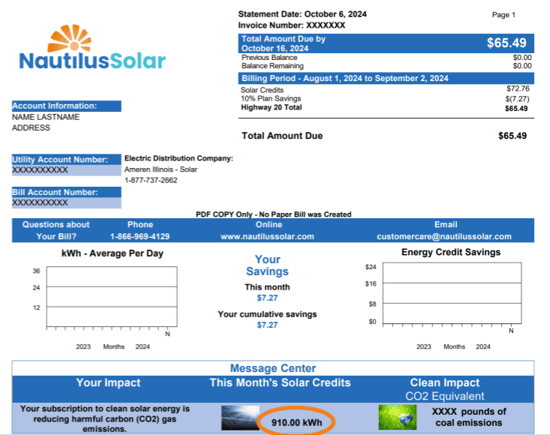
Solar credits are simply the equivalent amount of energy generated by Nautilus Solar instead of your utility company (in kilowatt hours). This energy is deducted from your utility bills and charged by Nautilus Solar at a discount.
You can find your monthly solar credits on your Nautilus Solar statement under 'This Month's Solar Credits'. See the example below:
Local Utilities
They satisfy their state mandated renewable energy goals and earn solar credits by purchasing solar power from energy providers such as Nautilus Community Solar to supply the grid with clean energy.
Community Solar Customers
We pass a portion of the solar credits back to our community solar customers at a discount of 5-25% annually through monthly solar credits. The difference between the total deducted from their utility company’s bill and the total billed by the owner/operator is the customer’s savings.